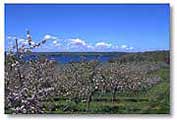
 Apple
Apple
Trees in Bloom |
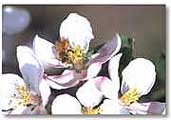 Bees
Bees
Pollinate the Apple Blossoms |
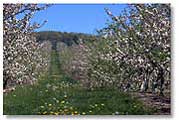 Spring
in New York Apple Country |
April
is the time to prepare for spring planting. The average tree will
bear fruit in three years, with full production coming in 8-10 years.
Most apple trees planted today are on dwarf stock, which are smaller
trees that grow more fruit than older traditional trees. This allows
for more efficient use of valuable land and labor.
Since
apples do not grow true to their seeds, young trees are grown in
a nursery from cuttings. Root-stock is selected for size and vigor,
which then receives grafting of the desired variety. Grafting involves
taping rootstocks and the budwood of a particular variety so that
the wood grows together to create a new tree. After the new trees
are established they are transplanted to the orchard site.
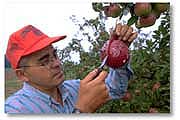
Spring
is a busy time in the orchard. The brush from pruning is picked
up or mulched back into the orchard soil. Grass is mown since it
competes for the soil nutrients and harbors pests. Growers start
using Integrated Pest Management techniques like monitoring the
weather while hanging various insect traps to collect data. Temperature,
humidity, and rainfall are recorded in orchard weather stations
to predict disease outbreaks and identify effective pest management
tools. Both harmful and beneficial insects are counted to determine
spray schedules. Spraying is done only when absolutely needed to
protect the tree and fruit.
The
most important spring activity is pollination, the process by which
new apples begin to form on the tree. Sometime around the beginning
of May, the buds begin to swell. Apple trees are covered with beautiful
clusters of fragrant blossoms as May goes on.
The
“King” blossom is the largest and center-most of clusters which
contain five blossoms. The opening of this blossom signals the time
for pollination to begin. Bee colonies rented from bee keepers must
be moved in quickly, usually at night when the bees are not as active.
Sunny mild days are needed during bloom to encourage strong bee
activity. Apples need pollen from more than one variety for the
cross-pollination that ensures good fruit set.

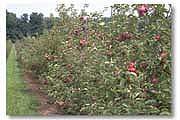 Apple
Apple
Trees in Summer |
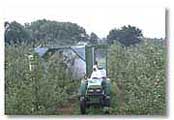 Spraying
the Crops |
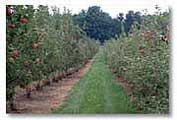 Summertime
in New York Apple Country |
Fertilizing
and tree training round out the busy June calendar. Small fruit
begins to form. Limbs must be tied up or weighted down to spread
the young tree into the perfect shape. The science and art of growing
apples, which is known as pomology, has become a very refined practice,
and apple producers attend regional meetings and classes to keep
abreast of the latest information and technology.
In
some dry years, irrigation must be used during July. Fruit size
and firmness are affected by moisture in this critical month. Spraying,
mowing, and shaping practices continue, and some summer pruning
is done to expose growing fruit to the sunlight for better ripening
and color.
August
is the last growing month before the apples begin to ripen. Red
apples need the assistance of cool nights during harvest to trigger
an enzyme which increases the amount of color or “blush”. Mowing
is completed and bins are positioned throughout the orchard. Ladders
are repaired and the harvest logistics are carefully planned.
Storage
rooms must be cleaned and their refrigeration systems tested. Most
growers store some of their fruit in Controlled Atmosphere (CA)
rooms where the temperature is rapidly brought down to between 32º
and 38º, depending on variety, and the oxygen is lowered and replaced
with nitrogen to slow the ripening process. Apples come out of these
rooms months later as fresh as the day they were picked.
Apples
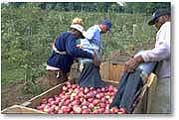
bruise easily and must be hand picked. Additional harvest workers
are hired both locally and from other areas to help get the crop
in on time. When picking begins around the end of August, there
is a constant buzz of activity until the last of the fruit comes
off near the end of October.
It
is now the job of the farmers to market their fruit, either through
their own farm store or packed and shipped fresh to supermarkets,
restaurants, and schools nationwide and around the world. During
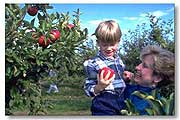
the harvest season, some farms invite the public to come for the
fun of picking their own apples.
Many
apples are processed into sauce, pies, slices and dried snacks.
Some apples are also pressed into fresh cider and processed apple
juice. Certain apple varieties are designed specifically for this
market.
With
the harvest complete, it is time to prepare again for winter. Growing
an apple takes all year, and there is always something going on
in the orchard. If you look closely, you can even see the promise
of next year’s crop in the bud at the top of each branch in the
snow.

Like
many living things, apple trees need to rest for part of the year.
This resting time is called dormancy. In January, while the trees
are dormant, pruning begins. Limbs are sawed off and clipped so
that the tree gets as much sunlight as possible. Pruning allows
the tree to produce larger, better colored, higher quality and more
valuable fruit.
Equipment
repairs and maintenance occupies the days of February and March
that are too cold or stormy to be outdoors.
|