 Apple
Apple
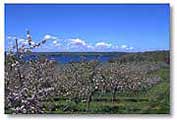
Trees in Bloom |
 Bees
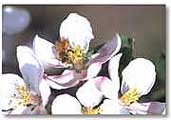
Bees
Pollinate the Apple Blossoms |
 Spring
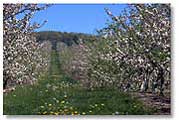
in New York Apple Country |
April
is the time to prepare for spring planting. The average tree will
bear fruit in three years, with full production coming in 8-10 years.
Most apple trees planted today are on dwarf stock, which are smaller
trees that grow more fruit than older traditional trees. This allows
for more efficient use of valuable land and labor.
Since
apples do not grow true to their seeds, young trees are grown in
a nursery from cuttings. Root-stock is selected for size and vigor,
which then receives grafting of the desired variety. Grafting involves
taping rootstocks and the budwood of a particular variety so that
the wood grows together to create a new tree. After the new trees
are established they are transplanted to the orchard site.
Spring
is a busy time in the orchard. The brush from pruning is picked
up or mulched back into the orchard soil. Grass is mown since it
competes for the soil nutrients and harbors pests. Growers start
using Integrated Pest Management techniques like monitoring the
weather while hanging various insect traps to collect data. Temperature,
humidity, and rainfall are recorded in orchard weather stations
to predict disease outbreaks and identify effective pest management
tools. Both harmful and beneficial insects are counted to determine
spray schedules. Spraying is done only when absolutely needed to
protect the tree and fruit.
The
most important spring activity is pollination, the process by which
new apples begin to form on the tree. Sometime around the beginning
of May, the buds begin to swell. Apple trees are covered with beautiful
clusters of fragrant blossoms as May goes on.
The
“King” blossom is the largest and center-most of clusters which
contain five blossoms. The opening of this blossom signals the time
for pollination to begin. Bee colonies rented from bee keepers must
be moved in quickly, usually at night when the bees are not as active.
Sunny mild days are needed during bloom to encourage strong bee
activity. Apples need pollen from more than one variety for the
cross-pollination that ensures good fruit set.
Click
on the Season to learn more!
|