Fresh
pressed New York State apple cider is available all year long.
Look for refreshing cider at your local farm market or supermarket.
Remember that fresh cider can be used in many cooking
recipes.
Is
Cider Pasteurized or UV Treated?
Most New York State cider is either pasteurized or treated with Ultra Violet (UV) light. Both processes are approved by the Food and Drug Administration, (FDA).
The pasteurization process involves heating the freshly pressed cider to 160 degrees for a few seconds. The high temperature kills bacteria that might be there. The cider is then immediately cooled to prevent it from getting a “cooked” taste. This process is the same process used to pasteurize milk. When done properly, pasteurization does not affect the flavor of the cider. Consumer tests have indicated that people cannot tell the difference between the flavor of pasteurized and un-pasteurized cider. Also, the nutritional value does not change. Some people simply prefer to drink fresh cider without any heat treatment or added preservatives.
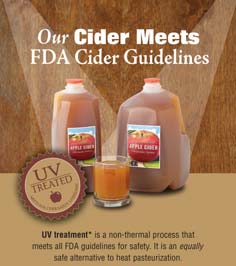
UV treatment is a non-thermal process that meets FDA guidelines to obtain a 5- log reduction of pertinent pathogens. This is equivalent to 99.999% safe. The UV or Ultra Violet treatment has the cider pass by an ultraviolet light which kills harmful bacteria. This process is called non-thermal because it does not heat up the cider. It is FDA approved and an equally safe alternative to heat pasteurization.
The New York Apple Association recommends drinking only pasteurized or UV treated fresh apple cider. This is to ensure that all consumers both young and old are protected against possible illness. Approximately 95% of the volume of cider currently produced in New York State is either pasteurized or UV treated.